This is a recording of a homily by Father Bernie Gilgun, from his weekly Mass at the Mustard Seed in Worcester, Massachusetts. You can download the mp3 (6.5MB) or see other formats. You can also subscribe (RSS) to the podcast.
Author: Mike
Discussing “A Good War Is Hard to Find”
 This week we’re publishing some thoughts on David Griffith’s book A Good War Is Hard to Find: The Art of Violence in America. We’ll be featuring Dave’s response, too.
The first reviews are from Mike Benedetti and Christine Lavallee.
Several of the essays in the book are available on-line, in excerpted or adapted form:
- Chapters One and Two (“Symphony No. 1 (In Memorium, Dresden, 1945)” and “Flannery O’Connor, Abu Ghraib and the Problem of American Innocence”)
- Prime Directive
See also:
- The “A Good War Is Hard to Find” blog
- Christopher Sorrentino’s review in the New York Times
God, violence, and what I watched growing up
Most young Americans don’t have a firsthand experience of war. Many grow up with no experience of intense violence at all. Their attitudes towards these things are shaped by art: books, TV shows, the news, and movies.
David Griffith, author of A Good War Is Hard to Find: The Art of Violence In America, is one of those people. So am I.
My peers and I really didn’t question violent entertainment while we were growing up, I think in part because we figured the stories told by adults were probably a good reflection of the world. (Today’s young people may be naturally more skeptical of these sorts of stories, since they can easily share their own videos with their peers over the Internet, and because their video games are more immersive—they can all use adult tools to act out their own stories. For people of my and Griffith’s generation, access to these tools implied some sort of legitimacy.)
In the essay “Some Proximity to Darkness” in Good War, Griffith revists the movies that shaped his sensibilities as a young man, this time taking a cold, hard look at them. I was shaped by many of these movies, and while reading the book I felt that Griffith was taking a cold, hard look inside my own head. Quite a trip.
Continue reading “God, violence, and what I watched growing up”
Subscribe to “Democracy”
The non-profit Participatory Culture Foundation is trying to raise extra donations as they push towards the 1.0 release of their open-source video player Democracy (Miro): “Because TV is too important to leave up to Microsoft and Apple.” (Cory Doctorow)
If you love this sweet piece of software (even my dad likes it), they’re asking you to “subscribe” and donate $5/month. In exchange, you’ll get a shirt with the new logo.
 My philanthropy strategy is to give to my church first, then to Oxfam or UNICEF for childhood disease prevention, then to small groups that are doing effective work in areas where a little work has a big impact. These days, for me, those would include groups like Vegan Outreach, Electronic Frontier Foundation, and the PCF.
Perhaps you would care to Digg this project.
CitySquare: money being spent, streets being named
A tipster points out that documents show the names of four streets in Worcester’s CitySquare project: an extension of Front Street, Mercantile Street, Eaton Place, and Trumbull Street.
City Manager Michael V. O’Brien said all the conditions of the General Development Agreement with Berkeley Investments Inc. of Boston, the project developer, have now been satisfied, enabling the city to proceed with its first disbursement at the negotiated sum of $6.1 million.
Mr. O’Brien said the amount, nearly $1 million less than originally projected, comprises expenses in the approved DIF program — such as tenant relocations, engineering, land transfers and design — that must be done for the new public street and block pattern, the public underground parking garage and other public amenities.
Midwest Catholic Worker retreat ends in protest, one arrest at Notre Dame
A few dozen members of the Catholic Worker movement staged a protest in front of the University of Notre Dame’s administration building today, saying the university’s ROTC program contradicts Catholic teaching.
“It saddens us that one of the preeminent universities is training warriors,†said the Rev. Ben Jimenez, a Catholic priest from Cleveland.
An appropriate quotation from the pope (Feb 18, 2007):
Why does Jesus ask us to love our very enemies, that is, ask a love that exceeds human capacities? What is certain is that Christ’s proposal is realistic, because it takes into account that in the world there is too much violence, too much injustice, and that this situation cannot be overcome without positing more love, more kindness. This “more” comes from God: It is his mercy that has become flesh in Jesus and that alone can redress the balance of the world from evil to good, beginning from that small and decisive “world” which is man’s heart.
This page of the Gospel is rightly considered the “magna carta” of Christian nonviolence; it does not consist in surrendering to evil — as claims a false interpretation of “turn the other cheek” (Luke 6:29) — but in responding to evil with good. (Romans 12:17-21), and thus breaking the chain of injustice. It is thus understood that nonviolence, for Christians, is not mere tactical behavior but a person’s way of being, the attitude of one who is convinced of God’s love and power, who is not afraid to confront evil with the weapons of love and truth alone. Loving the enemy is the nucleus of the “Christian revolution,” a revolution not based on strategies of economic, political or media power. The revolution of love, a love that does not base itself definitively in human resources, but in the gift of God, that is obtained only and unreservedly in his merciful goodness. Herein lies the novelty of the Gospel, which changes the world without making noise. Herein lies the heroism of the “little ones,” who believe in the love of God and spread it even at the cost of life.
Emphasis added.
See also: Father Michael Bafaro’s address to the Worcester March 24 antiwar rally.
Coffee in Worcester: Super Variety
This week, we talked with Bruce about Super Variety, a conveniece store across from Commerce Bank at 375 Main Street.
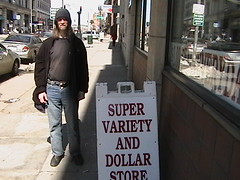
Pie and Coffee: Super Variety has Green Mountain coffee.
Bruce: That coffee was pretty good.
P: I love that place!
B: I think that coffee has got a snap to it.
Continue reading “Coffee in Worcester: Super Variety”
Continuing our struggle, and remembering El Salvador’s
Today is the anniversary of the martyrdom of Archbishop Óscar Romero, which happens to coincide with antiwar demonstrations across the country.
In honor of the former, here’s a prayer from Bob Waldrop.
As regards the latter, here’s a report from Bruce and I at the huge peace march in downtown Worcester, which drew as many as 250 people.

Roundtable discussion: How is Worcester treating the poor?
April 18, 7pm, 52 Mason St, Worcester. Refreshments. Co-sponsored by Real Solutions and the Catholic Worker.
Items, many about journalism
Thanks for the outpouring of support after I wrote I was sick! Some people would claim nobody reads this site, but I’ll tell you, at least my pals do. I’m feeling a little better today.
Binnacle of the week#
At Hooting Yard.
Tom Crouse watch#
From a rant about literacy:
There might not be a worse sign for country.
Zombies of Worcester#
I love the photo that illlustrates the Elm Park-Lincoln Estate Neighborhood Association’s article With Warm Weather Comes New Crime Concerns. What’s up with that guy’s hand? With warm weather comes—zombie attack!