Nonviolence, racism, and the state

You may recall my frustrated critique of the essay “Nonviolence as Racism.” One of many things I disliked about this essay is that it didn’t back up many of its assertions, and seemed more off-the-cuff than the subject deserves.

In trying to understand this line of argument, I stumbled across some references to Peter Gelderloos’s How Nonviolence Protects the State. I haven’t found much of the meat of this book online, but I did find this 7-part critique of the book by Parke Burgess. I plan to read this over the weekend.

I have chosen to devote considerable space to a critical review of this work not because it represents a formidable challenge to nonviolence in itself, but because it appears to collect under one title many of the grievances and frustrations of militant activists toward those who advocate nonviolent tactics.

(Everyone I talked to about “Nonviolence as Racism” disliked it, some intensely, but I have second-hand reports of people who agree with parts of it. I hope to track them down and talk about it.)

Kaihsu’s letter in the Guardian

P&C contributor Kaihsu Tai had a letter in yesterday’s Guardian:

Don Touhig and the Co-operative party’s People’s Rail campaign (Letters, June 25) has no credibility. The party is the junior partner in government with Labour, which has already had a decade to sort out the railways by reversing privatisation. As taxpayers, the citizens are already “shareholding members” of Network Rail. Adding another layer of membership is not going to make it a “mutual” – any more than an NHS trust becoming a foundation trust (with nominal, non-shareholding membership). The Co-op needs to break from its electoral pact with Labour and cooperate with voices for real collective change.
Kaihsu Tai, Janet Warren, Sid Phelps
Oxfordshire Green party

As usual with British politics, I have no idea what is going on.

508 #41: Cascading Waters

Tracy Novick takes us on a tour of Worcester’s Cascading Waters, a project of the Greater Worcester Land Trust.

[display_podcast]

Wild turkey at Cascading Waters

High quality (large) mp3, medium quality mp3 link, other formats, feed, low-fi versions

To get an e-mail each week alerting you of the new episode of 508, join the e-mail list:

Email:

We won’t share this list with others.

Nonviolence As Racism

I find this article from the Cleveland Catholic Worker to be deeply stupid: Nonviolence As Racism.

It jumps from a mild claim–that sometimes people promote nonviolence in a racist way–to extreme conclusions.

“. . . the system that white people have built to benefit us and only us — our courts, our laws, our whole political system . . . .”

Isn’t it racist (or perhaps just ignorant) to claim “the system” in this country is exclusively white? Haven’t people of all races and genders contributed, albeit to a lesser extent than white men, for both good and ill?

“As white radicals, we need to stand in solidarity with all liberation movements –regardless of the tactics they chooses.”

Really? If some ethnic group in the Balkans decides to use mass rape to liberate what they see as their homeland, should I support that? As someone whose ethics are based on my understanding of the teaching of Christ, I would find that hard to do.

“Criticizing ‘insurgents’ in Iraq who use any means necessary to combat the occupation and the white colonization of their land is racist.”

Can I criticize the methods they use to combat colonization by non-whites? What about that chunk of insurgency that’s about international smuggling and other crime rather than human freedom? Can I criticize their violence? What if I’m not close enough to the insurgency to tell the difference?

“Promotion the nonviolent struggles of King and Gandhi as if they were our own, commending these movements while criticizing other struggles for choosing other tactics is racist.”

I don’t want to dismiss the corrosive effects of white privilege, but are King and Gandhi on the other side of some absolute wall from me? Can’t I promote King’s philosophy as that of a fellow Christian American, while keeping in mind that he was to some extent struggling against my grandparents? Can’t I promote Gandhi’s struggle as that of a fellow inheritor of British imperial culture and a fellow human being? Isn’t linking my effort to theirs, despite their non-whiteness, in the spirit of them linking their efforts to Thoreau and Tolstoy?

“because this structure and the systems it creates are the real source of violence in this world.”

Why not claim the source of all violence is based in gender rather than race, or in Original Sin, or in power imbalances that predate “whiteness,” or in class, or in the fundamental orneriness of people? Why not acknowledge that the roots of violence are complex, and explore that complexity, rather than indulging in this breathtaking reductionism?

Personally, I think we should encourage everyone to practice nonviolence. We shouldn’t be racist about it, but we shouldn’t let our fears of promoting it imperfectly keep us from promoting it. We should keep struggling to love while helping others to do the same.

Book: Justice Seekers, Peace Makers

Another Michael True work posted online this week: PDFs from his book Justice Seekers, Peace Makers. Don’t be surprised if some of these chapters show up as future posts on Pie and Coffee.

  1. Martin Luther King, Jr. (1929­-1968)
  2. Howard Zinn (1921-)
  3. Fr. Daniel Berrigan, S.J. (1921­-)
  4. Muriel Rukeyser (1913­-1980)
  5. Mulford Sibley (1912­-1989)
  6. Hannah Arendt (1907­-1975)
  7. George Orwell (1903­-1950)
  8. Dorothy Day (1897­-1980)
  9. Ammon Hennacy (1893­-1970)
  10. Wilfred Owen (1893­-1918)
  11. Elizabeth Gurley Flynn (1890­-1964)
  12. Randolph Bourne (1886­-1918)
  13. Bertrand Russell (1872­-1970)
  14. Mohandas Gandhi (1869­-1948)
  15. Eugene Victor Debs (1855­-1926)
  16. Leo Tolstoy (1828­-1910)
  17. Abigail Kelley Foster (1811-1887) and Stephen Symonds Foster (1809-1881)

No “permit process” for Worcester federal building

This is the text of a document submitted today to Judge Timothy S. Hillman by Ken Hannaford-Ricardi. Emphases added.

Dear Judge Hillman,

At our June 16, 2008 pre-trial conference, Assistant U.S. Attorney Karin M. Bell’s written reply to our motion for the right to present evidence in support of a defense of necessity stated that the defense should be excluded as a matter of law because: “the defendants in this case had a very specific legal alternative they could have pursued. They could have requested a permit to enter the courthouse to perform a short prayer in protest of the war in Iraq. Indeed, the defendants were provided with this information by the U.S. Marshall upon entering the courthouse to pray.”
Continue reading “No “permit process” for Worcester federal building”

508 #40: Bad Sound Quality

508 is a show about Worcester. This week’s conversation is one of the best ever, but due to sound problems is almost unintelligible. Panelists are Brendan Melican, Jeff Barnard, Cha-Cha Connor, Kevin Ksen, and Dave Maciewski.

[display_podcast]

Topics include bears, Billy Breault, Barbara Haller, Counselor Palpatine, NebuAd, Tim Heard’s final blog post, “Q”, the Q, Mike’s pre-trial hearing, and lots of talk about hot dog vendors.

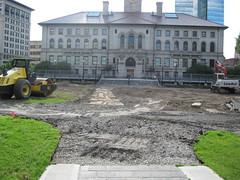
Pictured: The Commons is torn up again for a new ice skating rink.
Building the skate rink