I must be in an ascetic mood, because it doesn’t feel like “giving things up” for Lent will be much of a challenge this year.
Time was, giving up Facebook, or the radio, or coffee, felt like a real sacrifice. But this time around, as I wonder “Should I give this thing up?” that thing transforms into a burden in my mind, a burden it would be slightly painful to set down but which pretty quickly I would be glad to have cast off.
So I’m going to give up a whole slew of things this year, things I do to distract myself or pass the time but which I don’t really enjoy. There are a lot of those things! To keep the Lenten gameplan simple, all I’m going to commit to do with the resulting free time is pray a bit more than usual. My guide will be Bishop Robert Barron’s 2022 book of Lenten reflections.
In this post Zvi Mowshowitz breaks down “the sabbath” in a detailed (and secular) way I find inspiring. It’s helping me clarify my thoughts as I make my list of sacrifices.
This Lent will be a stressful one. The Pope has called for Ash Wednesday to be a day of prayer and fasting for peace in Ukraine. “It is a day to be close to the suffering of the Ukrainian people, to be aware that we are all brothers and sisters, and to implore God for an end to the war.”
Update: From River Sims’s Ash Wednesday message:
Dorothy Day once said in the midst of society’s fear of atomic bombs and concern over the war in Vietnam: “Go clean the toilets, and worry about the rest later.” Focus upon the need in front of your eyes, about which you can do something.
This Lent our focus is on our “flock” on the street, and my on inward remembering that “I am dust, and to dust, I shall return.”
It was suggested to use the word “stardust”, in administering ashes, and my answer: “We are going to die, we are mortal, and stardust takes way from the reality of dying.”
This morning, as I moved up the street placing ashes upon people sleeping in the doorways I received no harsh remarks, and approximately twenty-five out of fifty, were grateful.
For the first time, I did not wear a collar, a stole, a habit, and so in approaching each one they saw me simply as “River”, not the Church, from whom many have been rejected and hurt.
This afternoon I will be on the Haight and wearing my “normal” clothes, and while very few will receive ashes, again it will be just me talking and giving them food. I have some bracelets my friend Cindy has given us, with a little cross and color beads, and each one loves them.
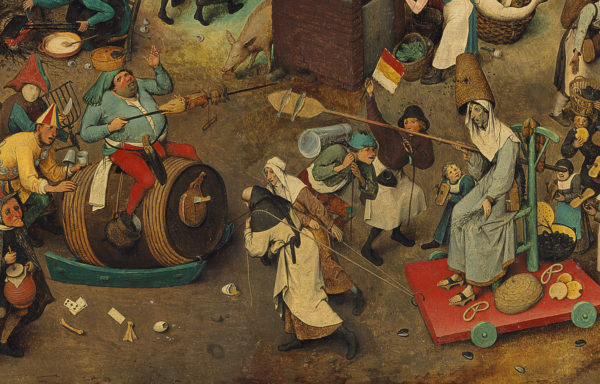
Image: Detail from Pieter Bruegel’s The Fight Between Carnival and Lent, 1559.