Hiroshima Day 2010, Worcester, Massachusetts

posted by Mike on August 6th, 2010

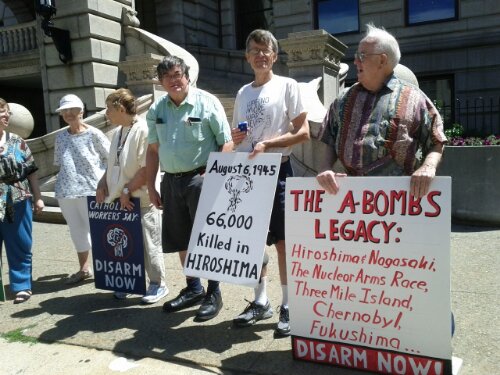
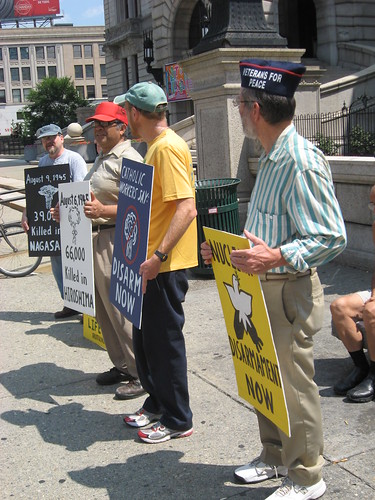
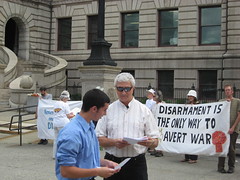
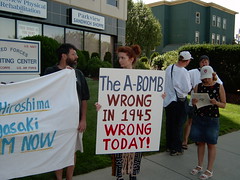
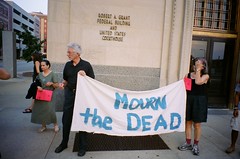
17 people gathered at Worcester City Hall today to repent, as Americans, for the 1945 atomic bombing of Hiroshima and Nagasaki, and to call for nuclear disarmament.

IMG_1554

Dave Griffith posted his great Hiroshima essay Pictures of the Floating World on his site today, in one of those Scribd-type crazy formats.

Related:

On Remembrance

posted by Kaihsu Tai on November 8th, 2009

Oxford Friends’ Meeting House (Quakers) on Remembrance Day 2009

This week in England, we were asked to ‘Remember, remember the Fifth of November’, and this Sunday – Remembrance Sunday – to remember the soldiers. It is well that we remember these; but I wonder whether it would have served us even better to remember that there had been three Anglo-Afghan Wars, before getting ourselves into a fourth one. The Encyclopædia Britannica has them thus: ‘The first war demonstrated the ease of overrunning Afghanistan and the difficulty of holding it. The second war proved to be a Pyrrhic victory for the British.’ So remember the poppy fields in Afghanistan, as well as those in Flanders, when you see the poppies this autumn.

posted by Kaihsu Tai in Creative Resistance, Itinerant Communicant, Oxford, Weapons | on November 8th, 2009 | Permanent Link to “On Remembrance” | Comments Off

Radical priest Carl Kabat profiled in NYT

posted by Mike on September 7th, 2009

Carl Kabat at the 2008 Catholic Worker national gatheringNice profile in today’s New York Times of Fr Carl Kabat, OMI, a Catholic priest with longstanding ties to both the Plowshares and Catholic Worker movements:

At 75 he continues his crusade against nuclear weapons at missile silos across the United States, armed with a hammer and a pair of bolt cutters. He usually wears a clown suit, in homage, he says, to St. Paul’s words: “We are fools for Christ’s sake.”

[...]

Subsequent protests led to Father Kabat’s spending more time in prison than out, raising questions about the effectiveness of his approach.

Liz McAlister, who married Philip Berrigan, has an answer. “We live in a culture where we want to measure everything to know how successful things are,” Ms. McAlister said. “It’s beautiful to see people who don’t spend time wondering and worrying about that and are willing to do what they think is right regardless of the consequences.”

Photo: Carl Kabat at the 2008 Catholic Worker National Gathering in Worcester.

Hiroshima Day 2009, Worcester, Massachusetts

posted by Mike on August 6th, 2009

11 people gathered at Worcester City Hall today to repent, as Americans, for the 1945 atomic bombing of Hiroshima and Nagasaki, and to call for nuclear disarmament.

IMG_0941

A recent poll found that 61% of Americans think the bombing was “the right thing” to do. There are two ways to look at this. Was the bombing an effective way to bring WWII to an end? Was the bombing a horrible crime?

I think the answer to the second question is “Yes.” As to the first, Wikipedia is a good place to start. Hiroshima: Was It Necessary? is another introduction.

For another take on disarmament, one expressed by several passersby today, see Randy Newman’s “Political Science.”

Related:

How to: commemorate the bombings of Hiroshima and Nagasaki

posted by Mike on August 5th, 2008

August 6 is the anniversary of the atomic bombing of Hiroshima. August 9 is the anniversary of the atomic bombing of Nagasaki.

One year in South Bend we held a Nagasaki commemoration and our signs were confusing to passersby. A short, clear sign might be NAGASAKI / 1945 / MOURN THE DEAD.

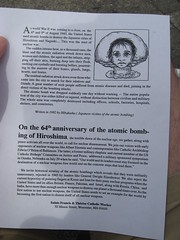
Here’s a leaflet with a Catholic focus you can customize.:

IM000165
Worcester, 2004

71330004
South Bend, 2006

IMG_0941 IMG_0934
Worcester, 2009

If you have constructive suggestions, or this info is helpful, please post a comment.

Rocket fuel into fertilizer

posted by Kaihsu Tai on April 22nd, 2008

The Yerevan Office of the Organization for Security and Co-operation in Europe reports that “Armenia’s entire stock of 872 tons of [the rocket fuel] mélange has been successfully recycled into an environmentally safe fertilizer, which was then provided to local farmers at no cost.” A modern case of swords into ploughshares. The project was part-funded by the United States of America.

posted by Kaihsu Tai in Creative Resistance, Environment, Weapons | on April 22nd, 2008 | Permanent Link to “Rocket fuel into fertilizer” | Comments Off

Pop Culture Peacemaker Shoutout

posted by Adam (Southern California) on June 30th, 2007

On last night’s Jeopardy!, the $1600 answer in the category “Rage Against the Machine” (all about people raging against machines, not about the band) was:

In a 1980 antiwar protest, these priest brothers, Daniel & Philip, attacked missile warheads at a G.E. plant.

Contestant Roy, a building inspector from Rancho Cucamonga, California, correctly, albeit ungrammatically, questioned, “What is Berrigan?”

posted by Adam (Southern California) in General, Weapons of Mass Destruction | on June 30th, 2007 | Permanent Link to “Pop Culture Peacemaker Shoutout” | Comments Off

The Spirit of Sakura

posted by Kaihsu Tai on April 25th, 2007

Author’s note: This is an essay I wrote in 1996 for the late Dr. Peter Fay‘s class, Hum 9a, at Caltech; transcribed with corrections in 2001. [Editor's note: Hiroshima is the subject of a chapter in David Griffith's A Good War Is Hard to Find, which we've been discussing here. Here are more of Griffith's reflections on the subject.]

I come from Taiwan, or Takasago, as one would call it back in the days of colonization under the Empire of Japan before the end of World War 2. Taiwanese people who are of my grandmother’s generation were educated to be Japanese; for example, the late pastor of my church, like many Taiwanese who were drafted by the Imperial Armed Forces at that time, was to be one of the kamikaze, the suicide pilots who were crashing their fighters into the carriers of the Allies. People of that age often talk to us about the times of the Japanese occupation and the Pacific War. Although they resented the unnecessary War they had to fight and complain about the occasional cruelty of the Japanese, they described the Japanese rule as a period of order and stability, in which even during the extreme of hardship near the end of the War, rarely did riots arise and corruption of the administration were unusual. It seemed that everyone in the neighborhood cooperated to remain organized for the War. I always wonder how this kind of disciplined behavior was attained.

After reading John Hersey’s Hiroshima, I think I know a bit more about the way of the Japanese. Although the emblem of the Japanese Empire is the glorious chrysanthemum signifying the Royal Family, common people refer to themselves as sakura, the cherry blossoms, which bloom brilliantly in the spring for a very short time, usually only a few days, and then fall to the ground. A respectful Japanese is one that suffers tragically, or even sacrifices oneself, for the cause of the greater organization (e.g., the Empire, or, as is observed in the modern, post-War society Japan, the kaisha, the Japanese idea of the “firm”), just like the sakura flowers. Any performance less than this is considered a shame in the Japanese mind.

Read the rest of this entry »

Pope and Trident, via Bruce Kent

posted by Kaihsu Tai on January 17th, 2007

The (UK) House of Commons defence select committee took evidence yesterday from Bruce Kent who quoted the Pope about His Holiness’s objection against nuclear weapons, according to BBC‘s Today in Parliament. Sadly, the evidence has not been transcribed on the web (yet), but readers can take a look at the report in the Guardian.

British arms trade inquiry

posted by Kaihsu Tai on January 16th, 2007

The Guardian has a thread of reports on arms trade being investigated by the (British) Serious Fraud Office. Readers might also want to check out the Campaign Against Arms Trade.

posted by Kaihsu Tai in China, Weapons | on January 16th, 2007 | Permanent Link to “British arms trade inquiry” | 3 Comments »