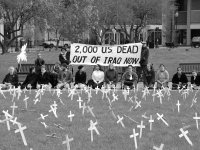
How to make 2,000 crosses

2000 crosses on Worcester CommonTo mark the deaths of 2,000 U.S. soldiers in Iraq, 2,000 white crosses were made and installed on Worcester Common. Here’s what we learned about making crosses.

Step 1: Materials

Ideally you’d find some scrap latticework, or some white, waxed corrugated cardboard. If a cemetary-supply company sells crosses cheap in bulk, that would be even better.

I was stuck using wood.

I used “pine strapping,” boards 1″x3″x8′. I could haul 50 boards in my minivan at a time.

I cut the boards in half widthwise, then into 1-foot sections, then cut these in thirds by thickness. I used a table saw. Some of the cuts were tricky.

Mike Leslie: You’re cutting the house in thirds?

Mike Benedetti: I’m cutting the halves in thirds.

The pieces are thus about a foot long, 1.5 inches wide, and 1/3 inch thick. (Actually, they’re a little smaller, because as you know a 1×3 board is not 1-inch by 3-inches. You knew that, right?)

One person with one saw can cut enough wood for 2,000 crosses in three solid work days.
Continue reading “How to make 2,000 crosses”

Items

Today: Homeless camp, South Bend CW zoning update, Pit Stop Ploughshares, Dwight Smith talks, Massachusetts parish comes out against Iraq war, Darfur, artists abroad.

Stopping plastic shopping bags

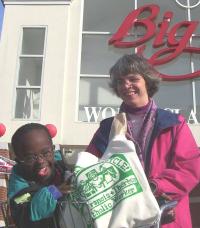
James and Abby Hannaford-RicardiThe Saints Francis & Therese Catholic Worker community here in Worcester worries about plastic shopping bags. They fill up landfills, clog storm drains, and litter the city.
The worst part is, nobody even needs them.

A few sturdy cloth bags can do the job as well as plastic (or paper) bags, and can be used over and over for years.

Making the transition requires two steps:

Step 1: Get the cloth bags. The Catholic Worker is making this step easy for dozens of Worcester shoppers. We’ll be giving out homemade canvas bags Nov. 9 to shoppers at the Big Y supermarket on Mayfield Street. These were made possible by generous donations and lots of sewing work.

(See also our instructions on sewing canvas shopping bags.)

Step 2: Change your shopping habits. This one isn’t too hard, either.

My parents live in a 2-story house, with the kitchen upstairs. My father made the transition from plastic bags by either using a couple of cloth bags for small shopping trips, or by putting groceries straight from his shopping cart into his car. He’s set up a sort of pantry downstairs by the garage, so he can move the groceries from the car to the pantry easily. He moves the groceries upstairs as needed.

At my own house, we always used some cloth bags, but always used plastic bags, too. Then we made a chart listing how many plastic bags we were using, how many paper bags, and how many times we used cloth bags.

Using plastic bags became a cause for shame. If you used a plastic bag, someone would look at the chart and say, “Hey, who used a plastic bag today?” It became competitive, and our plastic bag use quickly dropped to zero.

Here’s an article previewing the project in the Catholic Free Press: Canvas shopping bags to replace plastic.

Update: See our articles on making your own shopping bag out of canvas or old plastic bags.

Pictured: James Hannaford-Ricardi outside Big Y, rejoicing at his new canvas bag while his mother, Abby, looks on.

Remembering 2,000 US dead in Iraq

Two thousand U.S. troops have died in Iraq. In Indiana, where I am travelling, there are some statewide rallies planned for the weekend to use the 2,000 number to call for an end to the war/occupation. I think it is important to remember our fallen troops locally as well.

A memorial was held today at Worcester Common with 2,000 white crosses. Many photos at Indymedia.

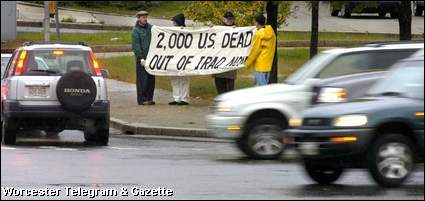
The photo below is from the Worcester Telegram & Gazette of yesterday’s Lincoln Square peace vigil, held weekly since 9-11-01.
Lincoln Square, Worcester
Continue reading “Remembering 2,000 US dead in Iraq”

Items

  • There will not be much Worcester news on this blog for the next couple weeks; I’m heading for the Catholic Peace Fellowship gathering in Indiana. Retreat leaders will include Paul Keim, Kathy Kelly, Bishop John Michael Botean, and Father Daniel Berrigan, SJ.
  • Worcester Magazine reports on a “west side crimewave” that neighbors are blaming on the hobo jungle in Beaver Brook Park.

    Word on the street is that the guys are vacating the lot now anyway as the weather turns cold. I think as many as a dozen people were sleeping there over the summer, although the cops would periodically raid the area and arrest some of the guys. When they were released from jail, they’d head right back to Beaver Brook.

    Also in WoMag, Phil Reid presents his vision for a compassionate city.

  • Catholic schoolteacher Stephen Kobasa lost his job because a new policy clashed with his longstanding distaste for saying the Pledge of Allegiance and for posting a flag in his classroom. The full story is worth reading.
  • The latest Pit Stop Ploughshares trial is coming up in Ireland. The last one ended in an early mistrial.
  • The South Bend Catholic Worker, which the city is trying to shut down through zoning violations, is playing the zoning game itself, thus far with no luck.

    Members of the Area Plan Commission of St. Joseph County voted to recommend that the South Bend Common Council turn down a request that zoning of the house at 1126 W. Washington St. be changed from single family to multifamily.

    (Full story in South Bend Tribune)

Fasting and Eating and Understanding

Today is Yom Kippur. It’s also Ramadan. Many are fasting today, and many who would not fast ordinarily are joining them. So if you see a bunch of people looking cranky and repentant, that’s what’s going on.

Yesterday was the Mayor’s Prayer Breakfast in Worcester. I’d heard of “prayer breakfasts,” but I’d never been to one, so I did a little research and found the Prayer Breakfast Network. Their website does not feature symbols of religion (Christian cross, Jewish star, Muslim crescent, Buddhist wheel) or breakfast (Northern bagel, Southern grits, Western omelette), just a bunch of American flags. Their spiritual heritage page is entirely about Anglo-Saxon Protestantism.

Maybe some towns could have a monocultural prayer breakfast like that, but not Worcester. The breakfast emcee was a rabbi, the opening prayer was by a Catholic bishop, the opening speech was by a city employee identified as a Unitarian, the keynote speaker was Bernard Lafayette (Baptist minister, among other things), and the closing prayer was by representatives from Hillel and the Islamic Society.

Then an Indian man who’d known Gandhi read a poem!

Stuff like that, and the City Council’s choosing religious tolerance over mosque wiretapping, makes me happy to be in Worcester.

Here’s another story that makes me happy to be in Worcester. It’s about some folks who decided to meet their new neighbors instead of fearing them. As told in Worcester’s Catholic Free Press:
Continue reading “Fasting and Eating and Understanding”

Social Service Siting Report and other items

The report of the “Mayor’s Social Service Task Force” is not yet public, but already plenty of folks in Worcester have their hands on it and are discussing it.

Worcester Magazine leaked the guts of the report yesterday.

Let’s look at what they said. I’ll comment in much more detail once the report is no longer confidential.
Continue reading “Social Service Siting Report and other items”